
Skip to Risk Management and Internal Control
Samruk Energy
EN

Risk Management 
and Internal Control

GRI 2-9, 2-12, 2-13, 2-16

In the sustainable development system of "Samruk-Energy" JSC, effective risk management plays a key role aimed at achieving strategic goals and minimizing potential threats. Risk management covers environmental, social and economic aspects of activities, as well as risks in the field of labour protection, corporate governance, compliance and legal compliance

The Company applies international standards, including COSO and the Three Lines of Defense model, which provide a systematic and comprehensive approach to identifying, assessing, monitoring and controlling risks. This allows management to make informed management decisions taking into account the short- and long-term impact of risks and improves the efficiency of business processes.

The main internal documents that determine the principles and elements of the risk management system, as well as the functions of its participants, are

  • Risk management policy in "Samruk-Energy" JSC
  • Rules for Identification and Risk Assessment of "Samruk-Energy" JSC
  • Regulation on the internal control system of "Samruk-Energy" JSC
  • Compliance Risk Management Policy of "Samruk-Energy" JSC
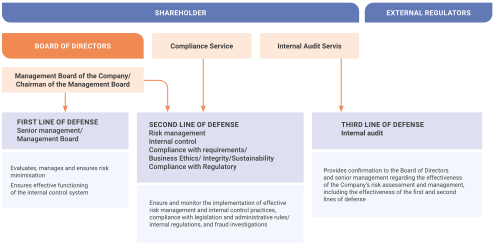
Risk management and internal control system
Shareholder
External regulators
Board of Directors
Compliance Service
Internal Audit Servis
Management Board of the Company/Chairman of the Management Board
First Line of DefenseSenior management/Management Board
Second Line of DefenseRisk managementInternal controlCompliance with requirements/Business Ethics/ Integrity/SustainabilityCompliance with Regulatory
Third Line of DefenseInternal audit
Provides confirmation to the Board of Directors and senior management regarding the effectiveness of the Company’s risk assessment and management, including the effectiveness of the first and second lines of defense
Evaluates, manages and ensures risk minimisationEnsures effective functioning of the internal control system
Ensure and monitor the implementation of effective risk management and internal control practices, compliance with legislation and administrative rules/ internal regulations, and fraud investigations

In 2025, as part of the implementation of the Roadmap for improving the sustainable development system of "Samruk-Energy" JSC, an extended identification and assessment of ESG risks was carried out. Particular attention was paid to environmental, physical and transitional climate risks included in the consolidated Risk Registers for 2025 and 2026.

For all identified risks, management measures have been developed taking into account possible consequences, which minimises the negative impact on the Company's activities. Climate risks (physical and transitional) are reflected in the risk management system and are not classified as key risks.

Quarterly Risk Management Reports with a description and analysis of key risks, as well as information on the implementation of plans and programmes to minimise risks of "Samruk-Energy" JSC were submitted for consideration by the Audit Committee in due time.

The internal control system ensures control of key business processes and timely informing management about risks and areas for improvement. Business continuity management is built in accordance with international standards and includes regular monitoring and testing of recovery plans.

In 2026, the development of the risk and business continuity management system will continue with an emphasis on supporting subsidiaries and affiliates.

Risk Appetite and Risk Monitoring

The Board of Directors approved risk appetite, which sets acceptable risk levels for the main areas of activity. Risk appetite is regularly reviewed and adjusted taking into account changes in the external environment and financial and economic parameters.

In June 2025, due to significant changes in key financial indicators, the implementation of major investment projects and changes in IRI, the risk appetite for 2025–2028 was updated.

Risk Management Action Plan

Annually formed and submitted for approval by the Board of Directors

  • Risk Register
  • Risk Map
  • Key Risk Indicators (CRC)
  • Key Risk Management Action Plan

Based on the results of risk identification of "Samruk Energy" JSC and subsidiaries for 2025, 34 risks were identified and assessed, the threshold values of the IF were updated, and the risk owners updated the factors and measures to reduce them.

Based on the results of the reassessment, seven risks are included in the key area of the 2025 Risk Map.

Name of the key risk
1 Risk of damage to the health and life of employees in the course of performance of official duties, accidents at work
2 Risk of accidents and disasters at work
3 Environmental risks
4 Risks of ongoing/prospective investment projects and investment programmes of subsidiaries and affiliates
5 Impairment risk of non-financial assets
6 Risk of tariff setting of natural monopoly entities
7 Interest rate risk

Risk map of "Samruk-Energy" JSC Group of Companies for 2025

5
54321
2 3 4, 5
Influence
6 7
12345
Probability

Key risks of "Samruk-Energy" JSC and measures to manage them

Description of the possible consequences of risk materialisationMain changesImplemented risk management measures
Risk of damage to the health and life of employees in the course of performance of official duties, accidents at work
  1. Harm to the health and life of production personnel
  2. Litigation, payment of compensation
  3. Decline in the reputation of the Company and subsidiaries
  4. Fines for violation of the requirements of the legislation of the Republic of Kazakhstan.
No change
  • Control over the implementation of measures developed within the framework of the Action Plan to achieve zero injuries in the group of companies of "Samruk-Energy" JSC in subsidiaries and affiliates. Quarterly monitoring of their implementation
  • Scheduled and unscheduled on-site inspections of subsidiaries and affiliates for compliance with regulatory legal acts and internal regulations in the field of occupational health and safety
  • Participation in the investigation of accidents (if they occur and are included in the order on the creation of the commission)
  • Monitoring the training of employees in the field of safety and labour protection, testing knowledge of the rules of technical operation, safety
  • Monitoring Contractors' Compliance with Health and Safety Requirements
  • Organisationand holding of meetings with the heads of subsidiaries and affiliates.
Risk of accidents and disasters at work
  1. Injuries and deaths at work
  2. Environmental damage
  3. Accidents, Failure of the I and II degrees in accordance with the Rules for Investigation and Accounting of Technological Violations. Technological failures of production equipment (emergency and unscheduled repairs of the generating unit)
  4. Undersupply of electric and thermal energy
  5. Unscheduled equipment repairs
  6. Occurrence of unforeseen expenses
  7. Equipment downtime
  8. Occurrence of losses due to compensation for emergency retired capacity at the price of electricity higher than the selling price
  9. Lack of electric power reserves in the power system of Kazakhstan.
No change
  • Control of timely diagnostics of equipment in order to determine the technical condition
  • Control over the timely and complete implementation of the necessary equipment repairs in accordance with the established schedule
Environmental risks
  1. Increase in payment rates for pollutant emissions
  2. Fines for violations of environmental and/or water legislation
  3. Negative impacts on fish populations and biodiversity
  4. Degradation of catchment areas
No change
  • Monitoring compliance with the norms of legislation in the field of environmental protection, water resources and deadlines for submitting applications for emission permits and reporting to state regulatory authorities
  • Monitoring of greenhouse gas emissions quota utilisation and adjustment
  • Compulsory environmental insurance
  • Interaction with authorised state bodies in the process of developing regulatory legal acts in the field of environmental protection
  • Monitoring of budget execution under the item "environmental protection"
  • Monitoring the impact of economic activities on aquatic ecosystems, fauna and flora
Risks of realizable/promising investment projects and investment programmes Subsidiaries and affiliates
  1. Economic inexpediency, including newly introduced technologies
  2. Increase in the cost of ongoing projects
  3. Increase in the time of project implementation
  4. Failure to achieve strategic goals to increase installed and available capacity and production volumes
  5. Failure to get the planned effect
  6. Decrease in the long-term value of assets
  7. Refusal of co-investors/partners to participate in ongoing joint projects
  8. Negative impact on the Company's reputation
  9. Technological failure of equipment
  10. Failure to implement economically feasible projects
  11. Failure to achieve project targets, decrease in investment efficiency
  12. Failure to disburse the planned funds for ongoing investment projects.
No change
  • Monitoring and adjustment of action plans for priority projects
  • Monitoring of ongoing investment projects
  • Report on the implementation of the Development Plan of Samruk-Energy JSC and Samruk-Kazyna subsidiaries and affiliates
  • Sending a presentation to Samruk-Kazyna JSC on ongoing and promising projects for a monthly hearing
  • Monitoring of the development of capital investments of "Samruk-Energy" JSC
  • Work with government agencies of the Republic of Kazakhstan to obtain support for the Company's investment projects
Impairment risk of non-financial assets
  1. Decrease in the value of assets, decrease in the investment attractiveness of assets, deterioration of reputation in the market, before the shareholder
  2. Disruption of the implementation of investment projects
  3. The need to revise the development strategy
  4. Potential mergers and acquisitions
No change
  • Reduction of capital expenditures, analysis of the feasibility of planned capital repairs, timely implementation of investment projects
  • Conducting an impairment test (if there are signs of impairment)
  • Centralised control over the formation and adjustment of the investment programme of subsidiaries and affiliates
Risk of tariff setting of natural monopoly entities
  1. Deterioration of the financial result of the Company's group of companies
  2. Failure to meet the indicators of the Development Plan
  3. Application of penalties.
  4. Increase in debt obligations
  5. Impairment of non-financial assets
  6. Decrease in investment attractiveness
  7. Deterioration of social support for personnel
  8. Refusal to implement long-term projects
  9. Cross-subsidisation of loss-making activities
  • Making proposals regarding the need to make appropriate amendments to the legislation of the Republic of Kazakhstan on the regulation of tariffs of natural monopolies, regulated markets and the competitive market
  • Timely identification of negative factors and risks in the field of tariff setting
  • High-quality preparation of the tariff campaign of the subject for the approval (coordination) of tariffs
  • Monitoring of tariff policy
Interest rate risk
  1. Increase in borrowed capital service costs
  2. Reduced profits
  3. Decrease in the volume of temporarily free funds,
  4. Increase in the payback period of investments
  5. Failure to fulfill contractual obligations to the creditor.
  6. Violation of financial covenants.
No change
  • Taking measures to optimise interest expenses
  • Generation and monitoring of the debt report to analyze changes in interest on loans