



Management principles
In "Samruk-Energy" JSC, the principles of sustainable development are integrated into key aspects of activities - from strategic priorities and business goals to corporate culture, internal processes and decision-making system. We consider sustainability as an integral part of the Company's long-term development, focused on a responsible attitude to the environment, creating a safe and supportive environment for employees, as well as ensuring reliable energy supply for consumers.
The principles in the field of sustainable development are based on the Company's desire to contribute to the 17 Global Sustainable Development Goals and adherence to the 10 principles of the UN Global Compact, which the Company joined in 2011. The Sustainability Guidelines of "Samruk-Energy" JSC are a fundamental document for improving the Company's activities in the field of sustainable development.
The principles of environmental protection, social responsibility and good corporate governance are being implemented in all areas of activity and are reflected in the relevant sections of this Report. Compliance with the Ten Principles of the UN Global Compact and their integration into the Company's activities are presented in the table below.
| Principles of the Global Compact | Report section |
|---|---|
| Businesses should support and respect the protection of internationally proclaimed human rights | Investing in human capital Sustainable Supply Chain and Procurement Policy |
| Businesses should not be complicit in human rights abuses | |
| Businesses should support freedom of association and the effective recognition of the right to collective bargaining | |
| Businesses should advocate the elimination of all forms of forced and compulsory labour | |
| Businesses should advocate for the total elimination of child labour | |
| Businesses should advocate for the elimination of discrimination in employment and occupation | |
| Business should support a precautionary approach to environmental issues | Caring for our planet Contribution to the fight against climate change |
| Businesses should take initiatives to increase environmental responsibility | |
| Businesses should promote the development and diffusion of environmentally sound technologies | Ethics and compliance system of fair business conduct |
| Businesses must oppose all forms of corruption, including extortion and bribery |
To manage environmental aspects, the Company has in place a set of corporate documents, including the Corporate Management System Policy, the Corporate Environmental Management Standard, the Environmental Emergency Response Manual, and the Environmental Safety Program, which form a unified framework for minimizing environmental risks.
The Company's economic activities, including issues of financial discipline and transparency, are carried out in accordance with the legislation of the Republic of Kazakhstan, International Financial Reporting Standards and internal corporate regulations governing tax, accounting and management accounting.
Procurement activities are regulated by the legislation of the Republic of Kazakhstan and the Procurement Procedure of Samruk Kazyna JSC. Procurement procedures are implemented by the authorised unit in order to ensure openness, efficiency and compliance with the established requirements when interacting with suppliers.
An important component of the ESG approach is occupational health and safety. The management system in this area applies to all employees and contractors and is implemented in accordance with the requirements of legislation and corporate standards, including the Strategy for the Development of the Industrial Safety System for 2024–2028 and the relevant standards for risk assessment and management.
In 2025, "Samruk-Energy" JSC consistently implemented its obligations in the field of social responsibility, developing responsible human capital management practices. The Company's approach is in line with the UN Sustainable Development Goals and is focused on ensuring safe working conditions, social protection of employees, equal opportunities and a favourable working environment. HR management is carried out on the basis of international practices, national regulations and internal corporate documents.
In the reporting year, the Fund's Corporate Social Policy Standard was approved, as part of the implementation of which fitgap analysis was carried out and measures were taken to develop processes in the field of working conditions, employee well-being, social risk management, human rights and inclusion.
Special attention is paid to the observance and protection of human rights. The Company integrates the relevant principles into all areas of activity, guided by the legislation of the Republic of Kazakhstan and internationally recognised standards, including the UN Guiding Principles on Business and Human Rights, the Principles of the UN Global Compact and ILO Conventions. Obligations in the field of human rights and social responsibility are enshrined in the Group's internal documents, and responsibility for their implementation is distributed among the Company's governing bodies in accordance with their competencies.
Sustainability Management
GRI 3-3
The Company's sustainable development principles are implemented in the context of three levels
Strategic integration - the principles of sustainable development are implemented in the Strategy (mission, values and strategic goals)
Operational integration - all corporate decisions are made by the Company's management based on the criteria of compliance with the principles and goals of sustainable development
Cultural integration is implemented as part of training, posting articles on the Company's corporate portal, as well as within the framework of the Code of Conduct.
Sustainability is integrated into
- management system (the management system in the field of sustainable development clearly defines and fixes the roles, competencies, responsibilities of each body and all employees for the implementation of principles, standards and relevant policies and plans in the field of sustainable development)
- development plan/strategy by integrating the goals of Environmental, Social, and Corporate Governance (ESG)

- Risk management system (continuous improvement of environmental and climate risk management practices associated with climate change)
- Investment decision-making process (analysis of material ESG factors and ESG risk assessment to identify investment risks and opportunities that are likely to affect the Company's performance)
- Remuneration system for supreme management and management bodies (the Company develops and publicly discloses ESG goals, ESG targets are used to assess the performance of managers)
- Key processes, including planning (long-term, medium-term (5-year plan) and short-term (annual budget) periods), reporting, human resource management, operations and others, and decision-making processes at all levels of government
- A system of regular interaction with stakeholders, which implies the provision of significant and reliable information, the possibility of a two-way dialogue, awareness of environmental hazards and risks associated with the Company's activities, and the development of a flexible complaint mechanism.
All information about the Company's principles, programmes, reports and new projects in the social, economic and environmental spheres is posted on the Company's corporate website in the "Sustainable Development" section as they become available. (GRI 224).
Sustainability management scheme of "Samruk-Energy" JSC
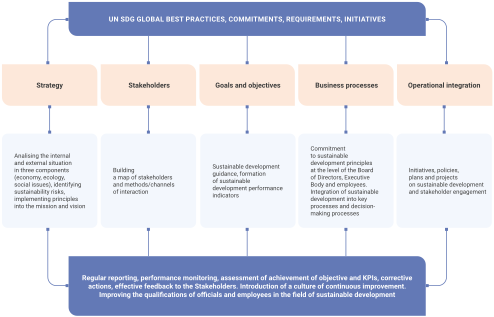
UN SDG Global Best Practices, Commitments, Requirements, Initiatives
Strategy
Analising the internal and external situation in three components (economy, ecology, social issues), identifying sustainability risks, implementing principles into the mission and vision
Stakeholders
Building a map of stakeholders and methods/channels of interaction
Goals and objectives
Sustainable development guidance, formation of sustainable development performance indicators
Business processes
Commitment to sustainable development principles at the level of the Board of Directors, Executive Body and employees. Integration of sustainable development into key processes and decision-making processes
Operational integration
Initiatives, policies, plans and projects on sustainable development and stakeholder engagement
Regular reporting, performance monitoring, assessment of achievement of objective and KPIs, corrective actions, effective feedback to the Stakeholders. Introduction of a culture of continuous improvement. Improving the qualifications of officials and employees in the field of sustainable development
The Board of Directors is responsible for the strategic direction and control of the implementation of sustainable development principles. His competence includes approving relevant policies and key performance indicators, as well as monitoring the fulfillment of the Company's obligations. Within the scope of its powers, the executive body ensures the implementation of sustainable development principles, compliance procedures and corporate policies, and also brings the results of this work to the attention of the Board of Directors.
The approved Motivational KPI Maps for managers of Samruk-Energy JSC for 2026 set ESG indicators, which ensures the integration of sustainable development principles into the management motivation system.
| Component | Indicator | % | Description |
|---|---|---|---|
| E (Environment) | Implementation of major and priority investment projects, including renewable energy projects and projects to reduce environmental impact | 30% | Implementation of investment projects, including projects operating on renewable energy sources and projects aimed at minimizing the environmental impact. |
| Development, approval of an action plan for the implementation of the Energy Transition Program of "Samruk-Energy" JSC until 2060 and the implementation of measures for 2025 | 20% | Development, approval of an action plan for the implementation of the Energy Transition Program of "Samruk-Energy" JSC until 2060 and the implementation of measures for 2025 | |
| Ensuring the level of specific consumption of equivalent fuel of national importance (EGRES-1, EKIBASTUZ GRES-2) | 20% | Improving fuel efficiency at key stations. | |
| Implementation of an automated system for monitoring emissions into the environment | 15% | Monitoring of emissions at EGRES-1 | |
| Dynamics of carbon intensity (3 years to the base year) | 5% | An indicator of the environmental friendliness of the electricity generated. | |
| S (Social) | Implementation of the Roadmap for improving the sustainable development management system of "Samruk-Energy" JSC for 2025 within the powers of the Management Board | 10% | Improvement of the sustainable development management system of "Samruk-Energy" JSC for 2025 within the powers of the Management Board |
| Industrial Safety (LTIFR, Behavioral Observations) | 10% | Reducing injuries and improving safety culture. | |
| Increasing the share of in-country value in procurement | 10% | Increasing the level of procurement with the highest share of intra-country value. | |
| Conclusion of off-take contracts | 20% | An off-take contract is an agreement concluded between a customer and a supplier for the supply of goods that the supplier plans to produce and ensure their delivery in the future, on pre-agreed terms in terms of cost, quantity (volume) and delivery time. | |
| G (Governance) | Implementation of large and priority investment projects | 30% | Implementation of the plan for 18 key projects of the group of companies. |
| Implementation of the Action Plan for Key Risk Management of "Samruk-Energy" JSC | 30% | The indicator is aimed at managing the key risks of "Samruk-Energy" JSC | |
| Approval of the Roadmap for the implementation of projects using artificial intelligence | 30% | KPI reflects the definition and implementation of projects using artificial intelligence in the group of companies of "Samruk-Energy" JSC | |
| Initiation/introduction of amendments to the legislation of the Republic of Kazakhstan on the energy sector | 25% | Timely initiation of amendments to the legislation of the Republic of Kazakhstan on the energy industry in order to protect the interests of the Company and its subsidiaries. | |
| Digital Maturity Assessment | 10% | Development of digital technologies, processes and competencies, the degree of integration of digital solutions into key business processes. | |
| Implementation of investment IT projects | 20% | Implementation of investment projects in the field of information technology aimed at digitalisation, automation and improving the efficiency of business processes. |