Skip to Determination of materiality and interaction with stakeholders
Samruk Energy
EN

Determination of materiality and interaction with stakeholders

Materiality assessment

GRI 3-1

Materiality assessment in Samruk-Energy JSC is aimed at identifying and prioritizing the most significant impacts of the Company on the economy, environment, people and human rights, as well as factors affecting business sustainability and long-term development of the Company.

Materiality assessment methodology

The process of identifying material topics included the following key steps.

Stage 1.Identification of potential material topics

At the initial stage, an expanded list of ESG topics was formed based on

  • analysis of the activities of "Samruk-Energy" JSC and subsidiaries
  • requirements of international sustainability standards, including GRI and the GRI 12 Coal Sector industry standard (2022)
  • SASB standards
  • lists of material topics used by leading ESG rating agencies in the electric power sector (S&P Global Ratings, MSCI ESG Ratings)
  • benchmarkanalysis of peer companies
  • analysis of the requirements of the legislation of the Republic of Kazakhstan and industry regulation
  • compliance with the UN Global Compact Principles and the UN Sustainable Development Goals.

As part of the process of identifying material topics, the Company conducted an extended analysis (benchmarking) of information disclosures in the annual reports of peer companies and industry leaders. This analysis made it possible to take into account the best practices of disclosure, additionally assess the relevance of a number of topics and take them into account when forming a list of material issues.

Indicator Samruk Energy JSC Enel GEZ group Unipro PJSC
Standards used
  1. GRI
  2. GRI 12 (Coal Sector)
  3. TCFD
  4. Standard for interaction with stakeholders
  5. UNGC
  6. UN SDGs 2030
  7. ISO Social Responsibility Guidelines
  8. IFR
  1. IFRS / IAS
  2. CSRD / ESRS
  3. EU Taxonomy
  4. TCFD
  5. IFR
  1. IFRS
  2. CSRD / ESRS
  3. EU Taxonomy
  4. TCFD
  5. GHG Protocol
  6. GRI / SASB
  1. GRI
  2. SASB
  3. IFR
  4. AA1000AP (Principles of Accountability)
  5. AA1000SES (stakeholder engagement)
GRI

E – GRI 302–306

S – GRI 401–409, 413–415, 418

G – GRI 201–207

E – GRI 207

E – GRI 301–306

S – GRI 401–409, 413–415, 418

G – GRI 205–207, 402, 2 9, 2 27

E – GRI 302; 303; 305; 306

S – GRI 401; 403; 404; 406; 407

G – GRI 201; 202; 203; 204; 205

Significant topics

Climate change and the environment

  • Climate change
  • Energy transition to sustainable sources
  • Energy Availability
  • Water Resources Management
  • Air quality
  • Rational waste management
  • Biodiversity

Caring for people

  • Management, development and motivation of employees
  • Safety and health in the workplace
  • Diversity, Equity & Inclusion

Good governance and integrity

  • Contribution to economic performance
  • Sustainable Supply Chain
  • Compliance and anti-corruption
  • Public policy
  • Climate
  • Workforce in the supply chain
  • Water and marine resources
  • Electrification
  • Resiliency and Reliability of Networks
  • Biodiversity
  • Circularity and waste management
  • Affected communities
  • Consumers and End Users
  • Business Conduct

(E) Strategic impacts

  • Greenhouse gas emissions
  • Consumption of Fossil Fuels and Non-Renewable Resources
  • Extraction and Disruption of Local Water Regimes and Ecosystems
  • Pollutant Emissions
  • Promoting Sustainable Energy Transformation
  • Impacts relevant to due diligence
  • Creating artificial barriers in nature that threaten biological diversity
  • Waste generation, including radioactive waste
  • Water withdrawal and water consumption

(S) Strategic impacts

  • Above-standard working conditions, training and retraining of employees
  • Impacts relevant to due diligence
  • Health, Safety and Other Incidents
  • Impact on local communities
  • Impact on local communitiesProtecting customer data and ensuring the reliability of information

(G) Strategic Impacts

  • Representation of women in leadership
  • Sustainable and secure corporate culture, support for innovation and education
  • Impacts relevant to due diligence
  • Supplier Relationship Management
  • Ensuring reliable, affordable and secure energy supply
  • Occupational health and safety
  • Economic performance
  • Ensuring decent work
  • Modernisation of production assets, improvement of efficiency
  • Anti-corruption
  • Effective corporate governance
  • Business ethics
  • Employee training and development
  • Air emissions
  • Community engagement and corporate social responsibility
  • Rational use of resources
  • Waste management
  • Energy consumption and energy efficiency
  • Water use

Stage 2. 
Taking into account the views of stakeholders

Based on the list of topics, a survey of all internal stakeholders and about 40 external stakeholders was conducted, in which respondents rated the importance of each topic on a scale of 1 to 5. The results obtained were used to form a materiality matrix and made it possible to compare the importance of ESG topics from the point of view of stakeholders and the Company.

Stage 3. 
Topic prioritisation

Topics were prioritised using the principle of double materiality. As part of the survey, internal and external stakeholders assessed the significance of topics in terms of the impact of the Company's activities on the environment, society, employees and local communities, as well as the potential significance of these factors for the Company's sustainability and development. In order to compile a list of priority material topics, the materiality threshold was set at the level of at least 4 points.

Based on the results of the survey and taking into account the requirements of GRI standards and industry specifics, a list of priority material topics was formed, which was approved by the Board of Directors of "Samruk Energy" JSC. The final list was also considered taking into account the strategic priorities of "Samruk Energy" JSC, long-term risks and opportunities, as well as the Company's obligations in the field of sustainable development.

Material topics of the Company
Significant topic Type of exposure GRI Standards Principles HD UN SDGs
Negative Positive Direct Indirect
Climate change and the environment
Climate change + + 305 7, 8 3, 12, 13, 14, 15
Energy transition to sustainable sources + + 302 9 7, 8, 12, 13
Energy Availability + + 302 9 7, 8, 11, 12
Water Resources Management + + 303 7, 8 6, 12
Air quality + + 301 7, 8 8, 12
Rational waste management + + 305 7, 8 3, 12, 13, 14, 15
Biodiversity + + 304 7, 8 13, 14, 15
Caring for people
Management, development and motivation of employees + + 401, 402, 404 3, 4, 5, 8, 10
Safety and health in the workplace + + 403 3, 8, 16
Diversity, Equity & Inclusion + + 405, 406 1, 2, 6 5, 8, 10
Good governance and integrity
Contribution to economic performance + + 201, 203 1, 3, 5, 8, 9, 11, 13
Sustainable Supply Chain + + 204 8
Compliance and anti-corruption + + 205 10 16
Digital solutions and AI + +
Data protection + + 418 1.2 9

Nature of impacts on material topics

The material topics identified in the materiality assessment reflect the key impacts of Samruk-Energy JSC activities on the environment, society, employees, consumers and the economy of the regions where it operates.

Environmental material topics (emissions, energy, water, waste) are related to the direct impact of the Company's production activities on the environment and climate, including the use of natural resources, emissions and environmental risks, as well as regulatory and transitional climatic factors.

Significant social topics (occupational health and safety, consumer health, employment, personnel development, human rights, data privacy) reflect the Company's direct impact on employees, contractors, consumers and local communities, including issues of safety, working conditions, well-being and social stability.

Economic and management topics (economic indicators, procurement, anti-corruption, taxes) are related to the impact of the Company's activities on financial stability, business transparency, compliance with regulatory requirements and stakeholder trust.

Stakeholder Engagement

GRI 2-29

"Samruk Energy" JSC builds systematic interaction with stakeholders based on the Sustainability Guidelines, the "Stakeholder Feedback Mechanism" Process Map, AA series standards and best international practices. This approach ensures the transparency of the Company's activities, taking into account the interests of key groups, and timely identifying and mitigating risks.

The Company has a Stakeholder Map approved by the Board of Directors. Stakeholder identification and ranking are carried out using the Mitchell, Agle, and Wood model, which takes into account influence, legitimacy, and urgency. Key stakeholders include shareholders, subsidiaries and affiliates, employees and trade unions, consumers, suppliers and business partners, government agencies, financial institutions, local communities and the media.

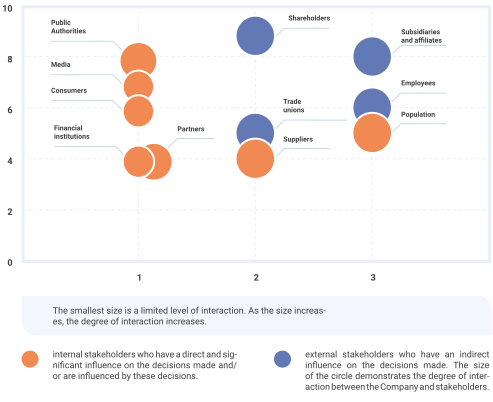
Below is a Stakeholder Map that visualises the structure of the Company's interaction, the X-axis reflects the degree of the Company's influence on stakeholders, and the Y-axis reflects their importance to the Company.

1231086420
PublicAuthoritiesShareholdersSubsidiaries and affiliatesMediaEmployeesConsumersTradeunionsPopulationFinancial institutionsPartnersSuppliers
The smallest size is a limited level of interaction. As the size increases, the degree of interaction increases.internal stakeholders who have a direct and significant influence on the decisions made and/or are influenced by these decisions. external stakeholders who have an indirect influence on the decisions made. The size of the circle demonstrates the degree of interaction between the Company and stakeholders.

To ensure a consistent dialogue, the Stakeholder Engagement Plan approved by the Board of Directors in 2021 and implemented on an ongoing basis is in place. Monitoring of its implementation is carried out annually. In 2025, all activities of the Plan were completed in full, including the implementation of similar plans by subsidiaries and affiliates as part of investment projects.

The Company develops cooperation with national and international industry organisations, participating in the formation of energy policy, improving the regulatory environment and promoting the principles of sustainable development. In the reporting year, the management of "Samruk Energy" JSC participated in the work of industry associations, expert groups, events of the Government and the Ministry of Energy of the Republic of Kazakhstan, as well as in international forums, including Kazakhstan Energy Week / Kazenergy.

Engagement with key stakeholder groups

Stakeholder's interest in the Company Mechanisms of interaction Results of interaction
Internal
Shareholder
  • Economic Profit / Consolidated Net Profit / Economic Performance
  • Free funds for development and dividends
  • Market Share / Market Presence
  • Social and environmental responsibility, minimisation of emissions into the environment, compliance with the principles of sustainable development, absence of complaints and fines for violation of environmental legislation.
  • Participation in meetings / periodic reporting of SamrukKazyna JSC on the results of the Company's activities for the reporting period
  • Reporting (financial, non-financial) in accordance with the requirements of the legislation of the Republic of Kazakhstan, internal regulations of the Sole Shareholder, relevant requests
  • Organisation of joint working groups, holding meetings, negotiations, meetings with interested parties
  • Formation of a media plan / publication of information on the Company's activities
  • Discussion of the implementation of the Development Strategy, business plan, implementation of investment projects and sustainable development processes, etc.
  • Meetings and correspondence on the activities of the Samruk-Energy JSC Group of Companies
  • Conducting surveys, questionnaires, testing
  • Internal corporate communication channels
  • Annual report and website of the Company.

For more information, see the Corporate Governance section.

Management and personnel
  • Employment, relations between employees and management, non-discrimination, diversity and equal opportunities, level of employee satisfaction with work, as well as the work of the Company’s services under their control
  • Training and education
  • Improving the level of production safety culture.
  • Fair and transparent conditions for remuneration of employees, ensuring professional growth of employees, safe working conditions
  • Development of human resources
  • Occupational safety briefings and implementation of programmes to improve working conditions
  • Implementation of social support measures for personnel and their families
  • Staff development, training and development programmes
  • Regular meetings with management, negotiations, meetings with the team, representatives of subsidiaries and affiliates, trade unions, including at the end of the year
  • Informing employees about the Company's activities and opportunities for professional growth through corporate websites and social networks
  • Conducting surveys, questionnaires, testing, annual monitoring of the personnel engagement indicator, the Hotline, internal corporate communication channels, and the Company's Internet resource.

For more information, see the ESG Governance section.

Subsidiaries and affiliates
  • Employment and pay, staff-management relations, non-discrimination, diversity and equal opportunities
  • Improving the level of production safety culture, training and education
  • Market share / presence in the markets of products and services
  • Assistance in working with government agencies, commercial interests.
  • Resolutions of the Company as a participant/shareholder of subsidiaries and affiliates
  • Verification of compliance with the legislation of the Republic of Kazakhstan and internal documents of the Samruk-Energy JSC Group of Companies
  • Audits of fulfillment of licence and contract obligations of subsidiaries and affiliates of Samruk-Energy JSC
  • Visits by the management of production sites of subsidiaries and affiliates
  • Development of proposals on amendments and additions to the legislation of the Republic of Kazakhstan
  • Provision of information at the request of state authorities in various areas of the Company's activities
  • Signing of contracts, memoranda, agreements on strategic cooperation
  • Orders and instructions, hearing of the management of the Company's subsidiaries and affiliates
  • Information/reports on the implementation of the business plan, production, investment and social plans/obligations, the achievement of key performance indicators and other relevant issues submitted to the Company
  • Continuous communication of target performance indicators, requirements for the development of internal regulatory documentation, etc.
  • Hardware, production, operational and other meetings, holding public hearings as part of the implementation of investment projects
  • Occupational safety briefings, training and education
  • Providing feedback on requests and complaints / hotline, social networks, internal corporate communication channels, annual report and the Company's website.

For more information, see the Key Financial Indicators, ESG Management, and Corporate Governance sections.

Trade unions
  • Job creation and preservation
  • Improving the level of production safety culture.
  • Holding public hearings
  • Signing of contracts, memoranda, agreements on strategic cooperation
  • Regular meetings with management, negotiations, meetings of teams, representatives of subsidiaries and affiliates, year-end report
  • Regulation of labour relations with the Company's employees
  • Remuneration of personnel in accordance with the labour legislation of the Republic of Kazakhstan, training and education, safe working conditions
  • Informing about the current activities of subsidiaries and affiliates
  • Acceptance of letters (appeals) of the Company
  • Hotline, social networks, internal corporate communication channels
  • Annual report and website of the Company.

For more information, see the ESG Governance section.

External
Public Authorities
  • Compliance, business stability and sustainability, tax revenues, economic growth
  • Job creation and preservation
  • Representation of the country's economic interests in the international arena (economic, political and image benefits for the country)
  • Increasing the level of energy and resource efficiency of production, preserving the environment to ensure public health and preserving biodiversity, minimizing emissions into the environment.
  • Audits of compliance with licence and contract obligations of the Company's subsidiaries and affiliates
  • Verification of compliance with the legislation of the Republic of Kazakhstan, development of proposals for amendments to the legislation of the Republic of Kazakhstan
  • Approval of subsoil use contracts, acts of state registration for the right to subsoil use
  • Information and reporting (financial, non-financial) in accordance with the requirements of the legislation of the Republic of Kazakhstan on the implementation of production, investment and social plans and obligations in accordance with requests
  • Negotiations, business correspondence, apparatus, production, operational meetings, questionnaires
  • Formation of a media plan and publication of information on the Company's activities
  • Hotline
  • Annual report and website of the Company.

For more information, see the sections "ESG Governance" and "Corporate Governance".

Consumers
  • Market Share / Market Presence
  • Quality of products and services
  • Marketing communications.
  • Customer feedback system
  • Holding meetings, negotiations, questionnaires
  • Formation of a media plan and publication of information on the Company's activities
  • Signing of contracts, memoranda, agreements on strategic cooperation
  • Hotline
  • Annual report and website of the Company.

For more information, see the Strategy section.

Suppliers of goods, works and services
  • Ensuring equal access to participation in competitions
  • Investment and Procurement Practices / Conclusions from the Implementation of Procurement Category Strategies
  • Supply Network and Value Chain Efficiency
  • Support for domestic producers.
  • Request for Quotation
  • Conducting regular analytical meetings, negotiations, business correspondence
  • Signing of contracts, memoranda, agreements on strategic cooperation, licensing
  • Information/reporting on the implementation of production, investment and social plans and obligations sent to the Company
  • Reporting on the results of the Company's financial and economic activities
  • Consideration of letters (appeals) addressed to the Company
  • Conducting surveys, questionnaires, testing
  • Hotline
  • Annual report and website of the Company.

For more information, see the Key Financial Indicators and ESG Management sections.

Business communities (Associations, National Chamber of Entrepreneurs, ALE)
  • Participation in the improvement and compliance with industry standards
  • Participation in improving the business environment
  • Support in government agencies through mechanisms of interaction between the business environment and government agencies, assistance in promoting the Company's legislative initiatives.
  • Development of proposals on amendments and additions to the legislation of the Republic of Kazakhstan
  • Signing of contracts, memoranda, agreements on strategic cooperation
  • Conducting regular analytical meetings, negotiations, business correspondence
  • Creation of working groups, holding meetings, negotiations, questionnaires
  • Annual report and website of the Company.

For more information, see "Strategy", Key Financial Indicators.

Community Organisations and Communities
  • Improving the level of production safety culture
  • Improving the level of energy and resource efficiency of production
  • Minimisation of emissions into the environment
  • Environmental protection issues within the framework of environmental impact assessment, including
  • atmospheric air
  • surface and groundwater
  • surface of water bodies
  • landscapes
  • lands and soil cover
  • flora
  • fauna
  • state of ecological systems and ecosystem services
  • Biodiversity
  • health and living conditions of the population
  • objects of special ecological, scientific, historical, cultural and recreational value.
  • Legal Compliance, Sponsorship and Other Assistance
  • Employment opportunities, solving social problems, transparency of the Company's activities, preservation of the environment.
  • Holding public hearings
  • Development of proposals on amendments and additions to the legislation of the Republic of Kazakhstan
  • Formation of a media plan and publication of information on the Company's activities in the media
  • Surveys, questionnaires, testing
  • Informing about the current activities of the Company and its subsidiaries and affiliates
  • Consideration of letters (appeals) addressed to the Company
  • Hotline, social networks
  • Annual report and website of the Company.

For more information, see the ESG Governance section.

Partners
  • Market Share / Market Presence
  • Joint implementation of projects
  • Transfer of Technologies, Competencies and Innovations.
  • Resolutions of the Company as a participant/shareholder of subsidiaries and affiliates, joint consultative and advisory bodies
  • Organisation of joint working groups, inspections
  • Meetings, negotiations, business correspondence, questionnaires
  • Reports on current activities
  • Correspondence on the activities of subsidiaries and affiliates
  • Annual report and the Company's website.

For more information, see "Strategic", Key Financial Indicators.

Financial institutions
  • Economic Profit / Consolidated Net Profit / Economic Performance
  • Free funds for development and dividends.
  • Provision of reports / information about the Company in accordance with the requirements of existing loan agreements
  • Submission of reports (financial, non-financial) in accordance with the requirements of the legislation of the Republic of Kazakhstan, internal regulations of the Sole Shareholder, relevant requests
  • Formation of a media plan and publication of information on the Company's activities in the media
  • Annual report and website of the Company.

For more information, see "Strategy", Key Financial Indicators.

International organisations
  • The Company's participation in international agreements and initiatives.
  • Conferences, forums, annual meetings
  • Signing of contracts, memoranda, agreements on strategic cooperation
  • Creation of working groups, holding meetings, negotiations, questionnaires
  • Annual report and website of the Company.

For more information, see "Strategy", Key Financial Indicators.

Creditors
  • Economic Profit / Consolidated Net Profit / Economic Performance
  • Free funds for development and dividends
  • Net asset value (NAV)
  • Investment and procurement practices / conclusions based on the results of the implementation of procurement category strategies.
  • Conducting regular analytical meetings and negotiations, business correspondence, questionnaires
  • Formation of a media plan and publication of information on the Company's activities in the media
  • Hotline
  • Annual report and website of the Company.

For more information, see "Strategy", Key Financial Indicators.

Local executive bodies
  • Compliance, job creation and retention, assistance
  • Occupational health and safety
  • Increasing the level of energy and resource efficiency of production, minimizing emissions into the environment.
  • Cooperation with local executive bodies in order to support and develop the social sphere of the regions
  • Organisation and conduct of volunteer and charitable events
  • Hotline, social networks
  • Annual report and website of the Company.

For more information, see "Strategy", Key Financial Indicators.

Media
  • Compliance, job creation and retention, safety culture
  • Economic Profit and Performance
  • Market Share / Market Presence
  • Improving the level of energy and resource efficiency of production
  • Minimisation of emissions into the environment.
  • Holding press conferences, providing press releases
  • Formation of a media plan and publication of information on the Company's activities
  • Hotline, social networks
  • Annual report and website of the Company.

For more information, see the ESG Governance sections.

Stakeholder engagement plan

"Samruk-Energy" JSC is constantly implementing the Stakeholder Engagement Plan approved by the decision of the Board of Directors dated 23 September 2021 (Minutes No. 10/21). Monitoring of the implementation of the Plan is carried out annually.

In 2025, the activities of the Stakeholder Engagement Plan of "Samruk-Energy" JSC were fully implemented (see Appendix).

Implementation of SEPs in subsidiaries and affiliates

Subsidiaries and affiliates of the Company monitored the implementation of the approved Stakeholder Engagement Plans for existing investment projects. Reports on the implementation of the TAC for key projects of AlES JSC, Moynak HPP JSC named after U.D. Kantayev and AZhK JSC were approved by the boards of directors of the relevant subsidiaries and affiliates in 2025.

Interaction with national and international organisations

"Samruk-Energy" JSC is a member of a number of national and international industry and public associations, including the CIS Electric Power Council, the Kazakhstan Electric Power Association, "Atameken" NCE of the Republic of Kazakhstan, the "KAZENERGY" Association, the Union of Mechanical Engineers of Kazakhstan, the ECOJER Association, the World Energy Council, the UN Global Compact and the National Confederation of Employers "Paryz".

Participation in these organisations contributes to the development of industry dialogue, the improvement of the regulatory framework, the strengthening of international cooperation and the promotion of the ESG agenda.

In 2025, the Company's management took an active part in meetings, meetings and industry events at the national and international levels, including Kazakhstan Energy Week 2025 and meetings of specialised associations.

Interaction with state authorities and the Shareholder

Government Relations (GR)

In 2025, the Company actively corresponded with government agencies and the sole shareholder on the implementation of investment projects, the development of green and traditional energy, as well as the initiation of changes in legislation.

In the reporting period, 10,677 incoming documents were received and 3,155 outgoing documents were sent. The company took part in the development and discussion of amendments to the Law of the Republic of Kazakhstan "On the Electric Power Industry", the rules for the functioning of the electricity and capacity markets, as well as in interdepartmental cooperation on promising digital and infrastructure projects.

Interaction with the Shareholder

In 2025, information and reporting support was provided for the Company's activities as part of Samruk-Kazyna's media plans, including coverage of investment projects, ESG initiatives and corporate events.

The Company provided timely managerial, financial and HR reports to the Shareholder, and also participated in monthly hearings on the results of activities (12 hearings).

Interaction with subsidiaries and affiliates

Interaction with subsidiaries and affiliates

Interaction with subsidiaries and affiliates is carried out in accordance with the principles of corporate governance and internal regulatory documents. In 2025, the Company's management regularly visited the production sites of subsidiaries and affiliates to monitor operational and social activities.

In 2024–2025, measures were taken to improve working conditions and sanitary infrastructure. In 2025, reporting meetings, meetings of collegial bodies and a strategic session on the implementation of the Development Strategy for 2024–2033 were held.

Internal stakeholders

The Company pays considerable attention to the development of corporate culture and the well-being of personnel. In 2025, sports, cultural and social events were held, as well as research on the well-being and social stability of employees.

The well-being index of administrative and managerial personnel reached 59% (an increase of 13 percentage points), the social stability index reached 77% (an increase of 8 percentage points), which indicates a positive trend in employee engagement.

Community engagement

In 2025, the Company and its subsidiaries organised public hearings as part of the implementation of investment projects in the field of renewable and conventional energy, as well as meetings with the population on tariff issues and projects for the modernisation of generation facilities.

Media Relations

In 2025, the Company ensured systematic and proactive interaction with the media. More than 100 materials were published in the media and social networks, interviews, press tours, briefings and excursions were held.

An increase in audience reach and engagement, an increase in the number of subscribers, views and interactions on social networks was recorded. Daily monitoring of the media field and prompt response to publications, including negative ones, were carried out.

Key partnerships

GRI 2‑28

Direction Table of Contents
Commitments and calls to action
  • UN Global Compact
  • UN Sustainable Development Goals
  • UN Women
Reporting
  • GRI
  • TCFD
  • IR
  • Kazakhstan Stock Exchange (KASE)
  • Astana International Exchange (AIX)
Membership and cooperation
  • KAZENERGY Association
  • Kazakhstan Electric Power Association (CEA)
  • CIS Electric Power Council (CIS EPC)
  • World Energy Council
  • National Chamber of Entrepreneurs of the Republic of Kazakhstan
  • Union of Mechanical Engineers of Kazakhstan
  • ECOJER Association
  • National Confederation of Employers 
of the Republic of Kazakhstan "PARYZ"
  • UN Global Compact
  • Carbon Disclosure Project (CDP)
Ratings and ratings
  • Fitch Ratings
  • Sustainable Fitch
  • PwC Kazakhstan
  • RAEX